- Home
- Community Resources
- Door County FiberNet
Door County FiberNet
National Consumer Protection Week March 1-7
This year National Consumer Protection Week will occur from Sunday, March 1 through Saturday, March 7. Government and nonprofit partners highlight information and resources to help consumers avoid scams and decrease their chances of becoming victims of fraud. The Federal Communications Commission wants consumers to understand their rights and make informed decisions when it comes to their telecommunications needs during and beyond National Consumer Protection Week. Follow the topics the FCC is highlighting throughout the week by visiting the FCC Consumer Help Center
You can find Consumer Protection Outreach Toolkits from the Department of Agriculture, Trade and Consumer Protection, as well as the Federal Trade Commission Consumer Advice.
Wisconsin BEAD Final Proposal Approved
Door County Impact
With the approval of the Wisconsin Final Proposal the Wisconsin Broadband Office has released funding information by County and Provider. You can view and search funded locations on the Wisconsin BEAD Awardees Map.
The total Door County award is $22,613,241.00 for 5,979 locations, the eighth highest award in the state. The technology breakdown is as follows: 5,504 locations were awarded fiber-to-the-premises, 151 locations were awarded fixed-wireless, and 324 locations were awarded low-earth-orbit (LEO) satellite.
The BEAD funding project performance period is a four year timeline. Contracting for grant agreements between the Wisconsin Broadband Office and internet service providers (ISPs) will begin after the holidays and more than likely thorough February. Additional administrative review steps that will need to be completed by the federal government before grant agreements can be issued.
Next steps after contracting for ISPs will be to move to engineering, environmental compliance and permitting. The hope is for ISPs to be able to break ground in the spring or early summer to start construction.
If you have any questions on your area or location please reach out.
Measuring The Economic Impact of Broadband Towards Secondary Residents of Door County Wisconsin
A recent study conducted by the University of Wisconsin-Whitewater Fiscal and Economic Research Center for the Door County Broadband Committee highlights the powerful economic benefits of expanding high-speed internet access in the county. With more secondary homes than primary residences, Door County relies heavily on seasonal residents, many of whom report that limited broadband keeps them from staying longer. The study found that with reliable, fast internet, secondary homeowners would extend their stays by an average of 15 days per year - generating over $18.6 million in new annual economic impact, creating 137 additional jobs, and adding $750,000.00 in state and local tax revenues. Expanding broadband in Door County means stronger communities, year-round economic vitality, and better opportunities for residents, businesses and visitors.
You can read the study here in the link. Measuring The Economic Impact of Broadband Towards Secondary Residents of Door County Wisconsin
Door County Recognized as One of the Nation's Digital Inclusion Trailblazers for the Third Time
The National Digital Inclusion Alliance (NDIA) named Door County as a 2024 Digital Inclusion Trailblazer. This national program recognizes the county's efforts to close the digital divide.
Recognizing the array of interests and unique barriers of its community members, Door County joins a record number of Digital Inclusion Trailblazers this year. NDIA awarded a total of 60 awardees representing municipal, county, and regional governments, paving the way for digitally inclusive communities across the US.
In an increasingly connected society, digital inclusion-access to affordable high-speed internet, devices, and digital skills training- is essential not only to participate in today's world but also to finding greater opportunities to thrive using tools to navigate the internet confidently and independently.
"In the past decade, we've seen local governments step into the important role of building digital inclusion ecosystems, where organizations that provide services can connect and thrive," said Angela Siefer, NDIA executive director. "NDIA's Digital Inclusion Trailblazers celebrates these critical efforts to bring digital opportunities to all residents."
NDIA's Digital Inclusion Trailblazers has set the national standard for excellent digital inclusion work since 2016. Each applicant's materials are verified for accuracy, assessed for community impact, and posted in an interactive map and searchable database on NDIA's website. By sharing materials with open-sourcing, NDIA provides community advocates and local governments ways to continue learning, connect with trailblazing peers, and plan their own digital inclusion solutions.
FCC Broadband Consumer Labels
The Federal Communications Commission (FCC) mandates that internet service providers display broadband nutrition labels, ensuring consistency in the information provided to consumers.
The "broadband nutrition label" is essentially a standardized way for internet service providers to clearly display key details about their plans, including monthly price, download/upload speeds, data caps, potential fees, contract terms, and other important information, allowing consumers to easily compare different options as they would with a food nutrition label; it's designed to help customers make informed choices about their internet service by providing transparent information at a glance.
You will see the broadband labels wherever you shop for internet. You may have to enter your address to see them, but all providers are now required to display them on their websites. If you notice that a provider isn't displaying labels or has inaccurate information about its plans, you can file a complaint with the FCC.
If you have a question about accessibility requirements for the Consumer Broadband Disclosure Labels, contact the FCC's Disability Rights office at 202-418-2517 for a vice phone call, at 844-432-2275 by videophone or by email at DRO@fcc.gov
Key elements on a broadband nutrition label:
Provider details: Name of the Internet service provider
Price: Monthly cost of the plan, including any introductory pricing, its duration, and any increases you can expect
Speeds & Latency: Typical download speeds, typical upload speeds and latency
Data allowance: Whether there is a data cap and the cost for exceeding it
Fees: Any Additional fees like installation, equipment rental, or early termination fees
Contract terms: If a contract is required, its length and conditions
Discounts & bundles: Any available bundled service discounts
Privacy policies: Link to the provider's privacy policy
Network management: Details about any network management practices
Customer support & Legal: Customer support contact information and links to legal disclaimers
Glossary: A glossary of terms is available in English or Spanish to help consumers better understand the information displayed on the label
How to use a broadband nutrition label:
Compare plans: Look at the labels from different providers side-by-side to easily compare prices, speeds data caps, and features.
Check for hidden fees: Pay attention to any additional fees listed on the label, such as equipment rental or installation charges.
Consider your needs: Based on your typical internet usage, decide which plan offers the best combination of speed and data allowance for your needs.
Understand data caps: If a plan has a data cap, be sure to check how much data is included and the cost for exceeding it.
Help Us Get Internet to Your Home or Business!
We need all property and business owners to participate in this survey to show what internet services are in place in the County. It is projected to cost $140 million for Fiber to the Premises in Door County. It is critical for us to obtain as much Federal and State funding as possible to help offset the cost, to ensure that connections are funded to every resident and business in the County.
Every survey completed can help your Municipality qualify and apply for more State and Federal grants to help pay for Fiber to the premises.
We need you to complete this short 10 minute survey that includes an internet speed test from your home, business and every property you own. Please use a computer or tablet to access the survey here https://maps.psc.wi.gov/apps/WISER/index.html . We would prefer no cellular connected devices please. The funding focus is for wireline service that is directly connected to your home, not cellular service.
If you do not have internet access from your home or business OR you only have cellular access-please call the State of Wisconsin Consumer affairs 608-261-6026 for a short survey over the telephone.
If you do not have service at your location, you can also email or call me, the County Broadband Coordinator with your location information, and I can enter your location without service into the database. You can see my contact information below my picture to the right.
You can view the survey responses on our Broadband Planning Map and see the countywide progress.
If you are struggling with data caps the FCC would like to hear from you. The FCC has established a Data Caps Experience Form so everyone can share their unique experiences and challenges with data caps. By sharing their data cap stories about their fixed or wireless broadband plans, consumers will help the FCC understand how data caps impact access to broadband for all individuals, including: You can submit an electronic Data Caps Experience Form from this Link, or if you would like to fill out a Paper Form and submit it you can use that. If you need assistance in this, please contact me.
- Individuals with disabilities
- Low-income consumers
- Historically disadvantaged communities
- Access to E-911 services, emergency alerts, or other public safety services offered over the Internet
- Access to online education
- Access to telehealth
- Access to remote work
If you find your connection is struggling with the speed test here is some information on why.
Latency is the time it takes for a data packet to travel across a network from one point on the network to another. High latencies may affect the perceived quality of some interactive services such as phone calls over the Internet, video chat and video conferencing, or online multiplayer games. All network access technologies have a minimum latency that largely is determined by the data rate limitations of the technology. There are many other factors that affect latency though, including the location of the server with which one is communicating, the route taken to the server, and whether or not there is any congestion on that route.
Packet loss measures the fraction of data packets sent that fail to be delivered to the intended destination. Packet loss may affect the perceived quality of applications that do not incorporate retransmission of lost packets, such as phone calls over the Internet, video chat, certain online multiplayer games, and certain video streaming services. During network congestion, both latency and packet loss typically increase. High packet loss degrades the achievable throughput of download and streaming applications. However, packet loss of a few tenths of a percent, for example, is common and is unlikely to affect significantly the perceived quality of most Internet applications.
DISCLAIMER: Your responses will be reported in public maps and other reports without addresses or other explicit identifying information. To further protect privacy, data may be presented in an aggregated or suppressed format. In accordance with the Children's Online Privacy Protection Act (COPPA), this survey may only be completed by individuals age 13 or older. By completing this survey, you are acknowledging being at least 13 years of age.
"Thank you for taking our survey."
County Broadband study implementation recommendations from the Broadband Steering Committee & endorsed by the DCEDC Board of Directors.
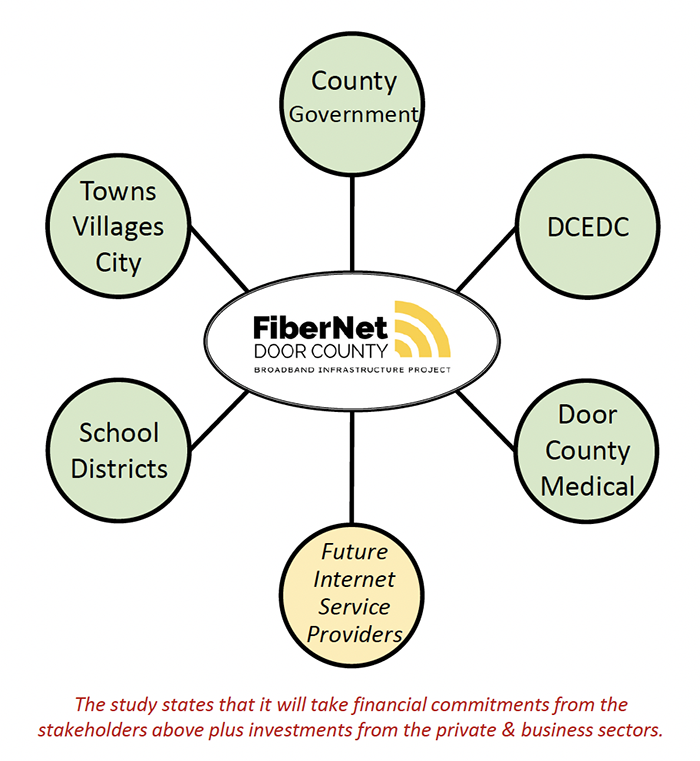
Key Study Findings / Recommendations
• The study provides a general design model that can be replicated throughout the County and it should be utilized as the guide for implementing broadband in the County.
• We knew we had issues, but this study defines how poor our service is in the County which will help enable grant funding.
• While there are significant public resources available for broadband, it will still require local investments to accomplish the countywide vision.
• Broadband is not a luxury, it is a necessity like electricity.
• Like electricity, it will require partnership between the private and public sectors.
• Door County needs a dedicated “leader and champion” for the overall broadband strategy to be successful.
• To accomplish a federated network, we will need to work together to ensure connectivity and efficient use of funds.
• We will need to build partnerships with potential Internet Service Providers (ISPs) to be successful.
• It will take time and persistence at the local, county and state level.
Read more from the study.